The raccoons find their own work, and you never get to be one of them. Still, now and then six of them need to be picked up and sent to bed. This one is about your hands.
Click, drag, or a moment’s patience
The mouse now tells three gestures apart. A click on a raccoon selects him and opens his card. A quick drag pulls out a box and selects the raccoons in it. And if you hold the button a moment before dragging, a yellow box marks everything there is to gather: trees, berry bushes, mushrooms, things on the ground, ripe grain. A label by the pointer keeps count, say „Chop: 6 trees“. Mushrooms the colony knows to be poisonous are left out. You may have forgotten. The raccoons have not.
A right click sends the selected there. They spread out round the spot and wait for as long as they stay selected. Deselect them and they go back to work as if nothing had happened. A right click on a tree sends them chopping, on prey hunting.
Who’s selected knows it
Ctrl and a number store the selection as a group, the number brings it back. A bar along the bottom shows who is selected: a portrait, a name, health, and a badge when something is wrong or when he is waiting. The portraits are not drawn in advance. A little photo studio hidden off the island takes each raccoon’s picture in his own cap and shirt, always by daylight, even at midnight in a thunderstorm. Change hats, and he gets his photo taken again.
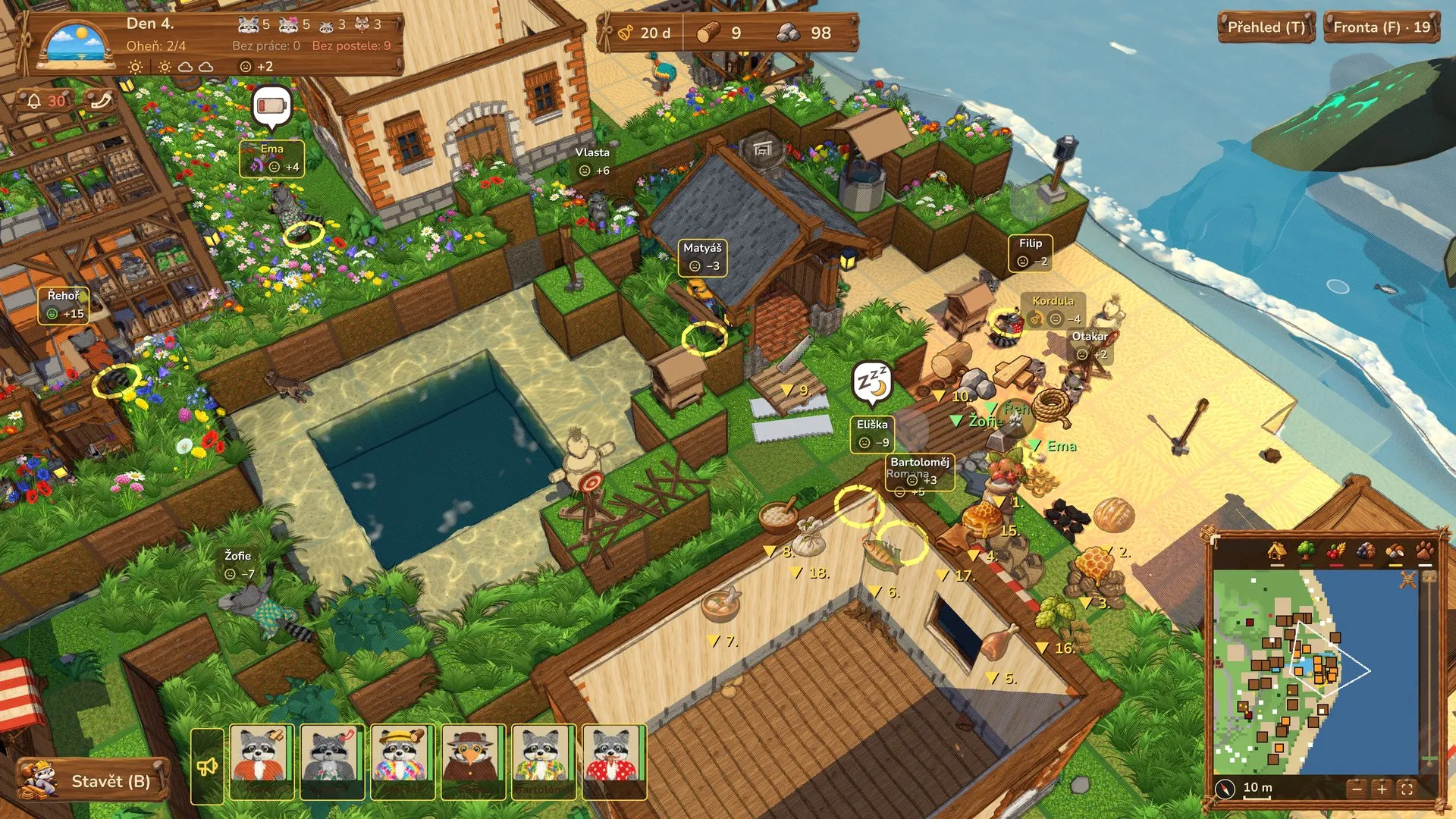
A button at the end of the bar opens Orders for the selected: eat, drink, sleep, arm up, get dressed, drop it, go home and let go. Whoever can take an order takes it, and the hint says how it went: „Drop it: 2 of 6 (4: carrying nothing)“. Only one of them answers with a bubble. Six at once would be a choir.
A card with drawers
The radial wheel round a raccoon is gone. His orders are wooden planks right in the card, and the card is now five tabs: Gear, Feelings, Bonds, Nature and Professions. His feelings used to hide in a little card that popped up only when you hovered over his face. If you didn’t know, you never learned a thing about his inner life. Now it has a drawer of its own.
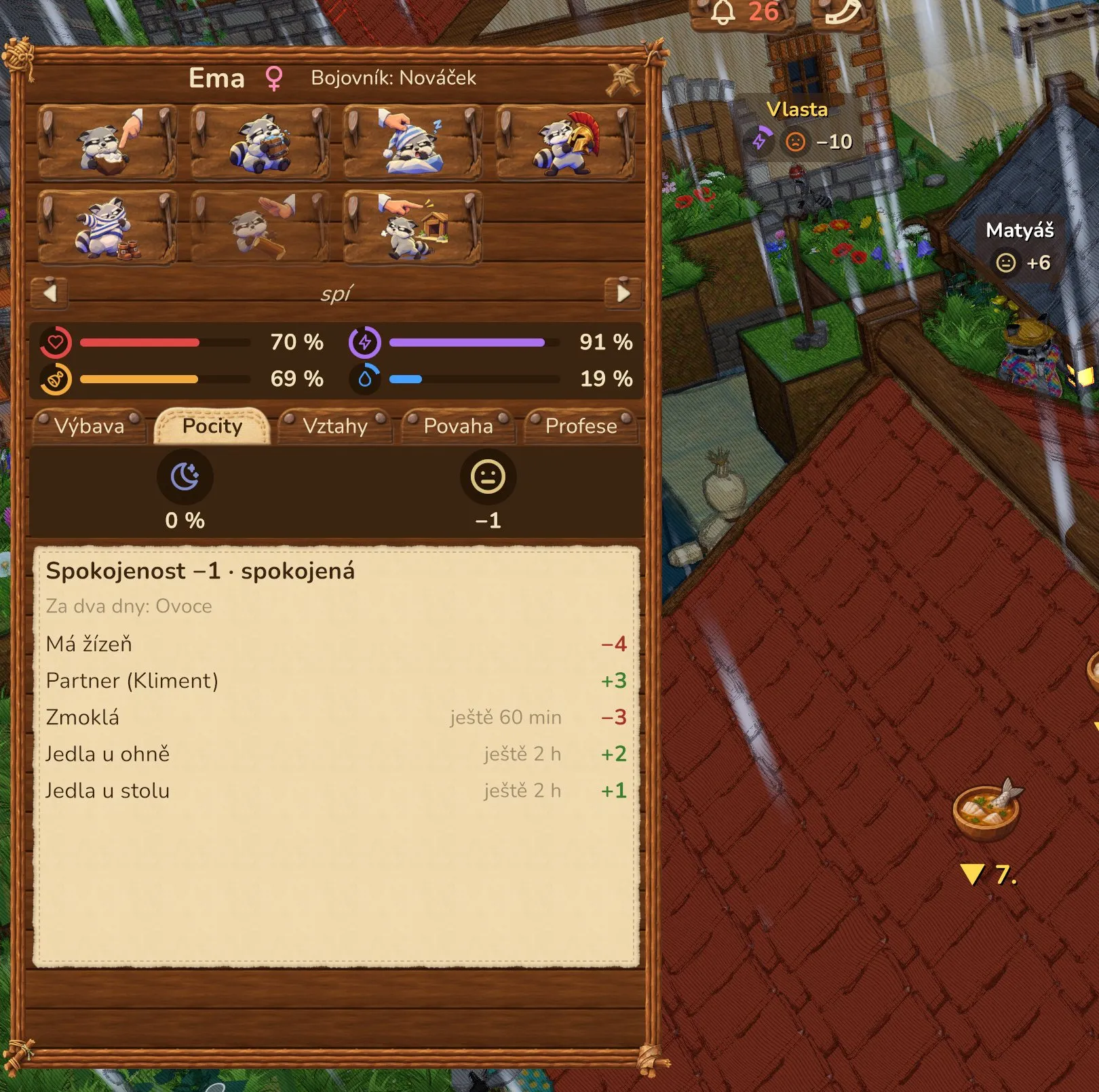
Over their heads hangs only what needs attention: the name and the mood, and a need only once it runs low. Tab switches to everything, to names alone, or to nothing.
Alt no longer sees through hills
Alt shows icons of everything the raccoons have seen, and until now it showed them across the whole island, behind mountains too. Now only round where you are looking: zoomed out you see far, down by the ground you see your surroundings, and what a hill hides stays hidden. The raccoons don’t have X-ray vision either.
One Overview instead of five windows
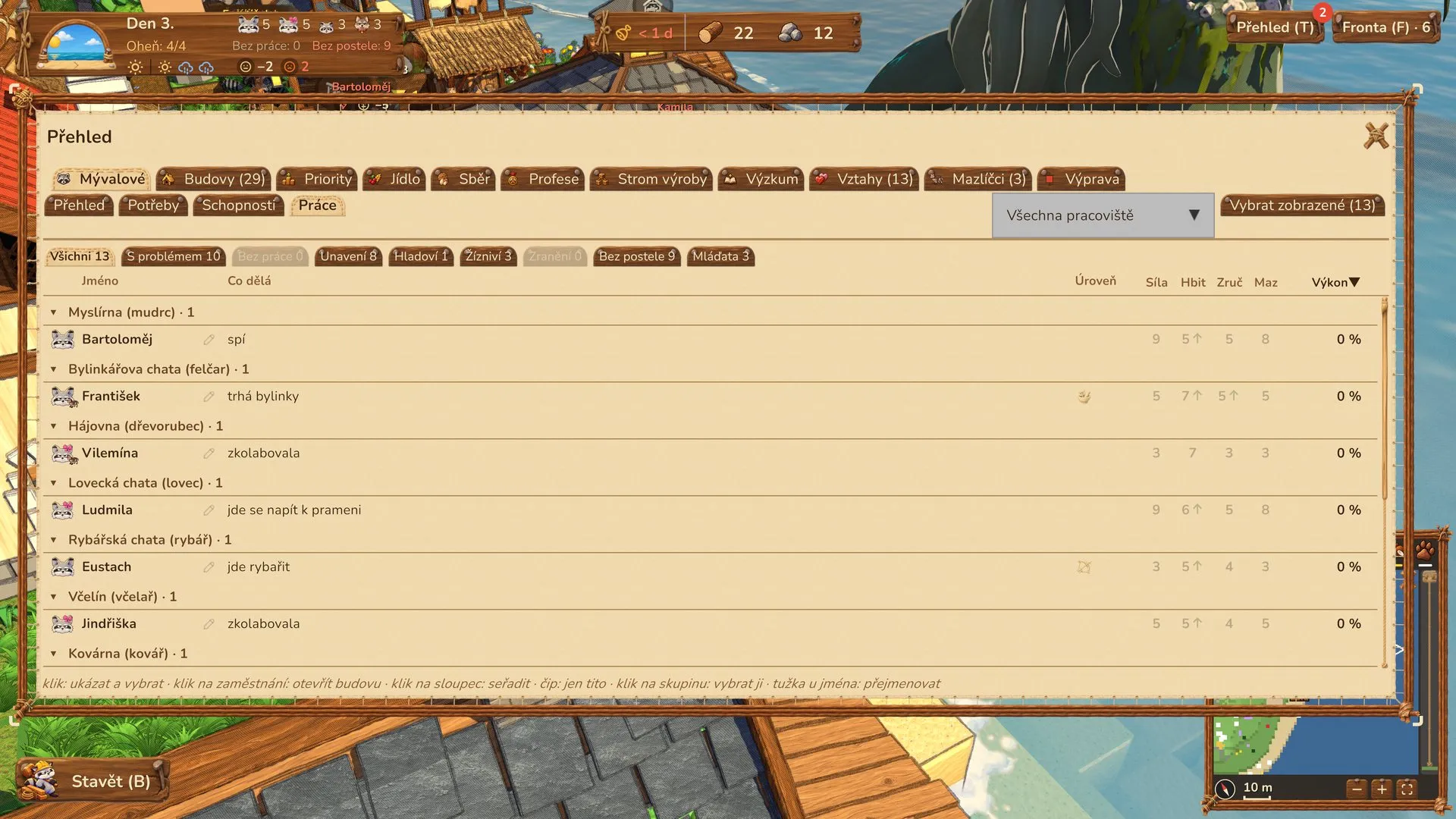
T opens the Overview: raccoons, buildings, priorities, food, professions, research, relationships, pets and the expedition, all tabs of one window. The Buildings tab gives every building a row: what it does, who works there and, in red, why it stands idle.
The raccoons’ table has four views (Overview, Needs, Skills, Work) and above it chips with counts that are filters too: Issues, Idle, Tired, Hungry, Thirsty, Hurt, No bed, Young. The Work view groups the raccoons by workplace and sorts them by output, so you see at a glance who saws fastest at the sawmill and who should be doing something else. And Select shown selects whatever the filter shows. Hungry, select, eat. Famine solved in a few clicks.
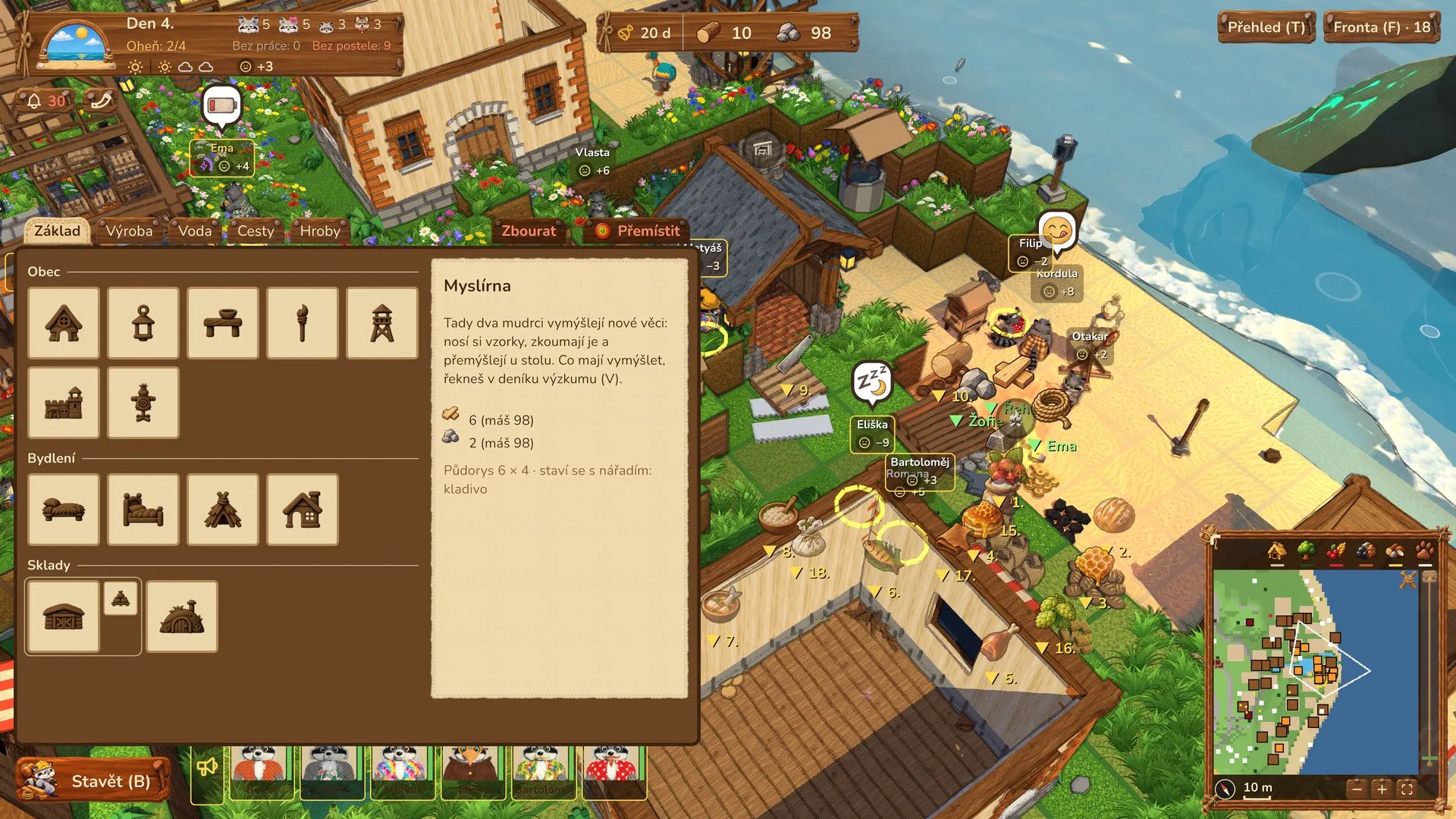
A build menu with shelves
The build menu’s tabs are split into groups with headings: Basics into Village, Housing and Stores, Making into Gathering, Crafts and Farm. Small add-ons sit beside their building in a frame: the farm with its field, fence, gate, feeder and granary, the apiary with its hive. A cost is just an icon and numbers, „2 (you have 20)“; point at the icon to learn what it is.
Svatopluk, also known as Septimus
The game now speaks Czech, English and Spanish. The language switches in Settings, at once, even halfway through a game. More than four thousand texts went across, the raccoons’ names among them: Svatopluk is Septimus in English and Sebastián in Spanish, Bořek is Barnaby and Bernabé. A name you give a raccoon yourself stays as you typed it. Svatopluk, who fell asleep in Czech and woke up as Septimus, didn’t notice a thing.
Before you sail
Behind the main menu, instead of dark planks, five raccoons now sit round a campfire above the sea. They chat, dance now and then, and every so often one gets up, takes a little stroll and sits down again. The only raccoons in the game who never work.
Under the game’s name is your profile: each player has their own game, keys, windows and language, so siblings sharing a computer no longer overwrite each other’s colonies. In a new game, under Start, you set how many raccoons sail, how many supplies they take, and how many wolf cubs, pairs and young come along. Everything invented lands the colony with the whole of research already in its head.
The map studio
Hand-made maps come from the author’s studio. The island’s form is picked by buttons showing its outline, brushes raise, level, paint surfaces and hollow out caves and show beforehand which cubes will appear and which will go. The bucket pours an edit over a whole joined area of one height. A map can hold buildings that stand from day one, and the check says what the map still lacks before the Play button sends it into the game. The studio speaks only Czech. The raccoons have never complained.
Little things
- The cursor is a paw. It points at what you can click, grabs while you drag and wags a finger when something won’t do. At night it casts a soft light round itself.
- Digging without a menu. Shift and a click digs, Shift and a right click heaps, Shift and the wheel cuts the island layer by layer.
- Clearing without a tool. A click on nettles, ferns, a bush with no berries or unripe grain marks it to be cleared.
- The middle button pans the camera, and a selected raccoon’s ring shows even through tall grass.
Now you know how to pick the raccoons, send them and count them. Nobody promised they would listen.