A building under construction used to stretch like dough. A mill two fifths done looked like a squat barrel, and nobody could tell whether it would end up a mill or a brewery. Not any more.
From the ground up
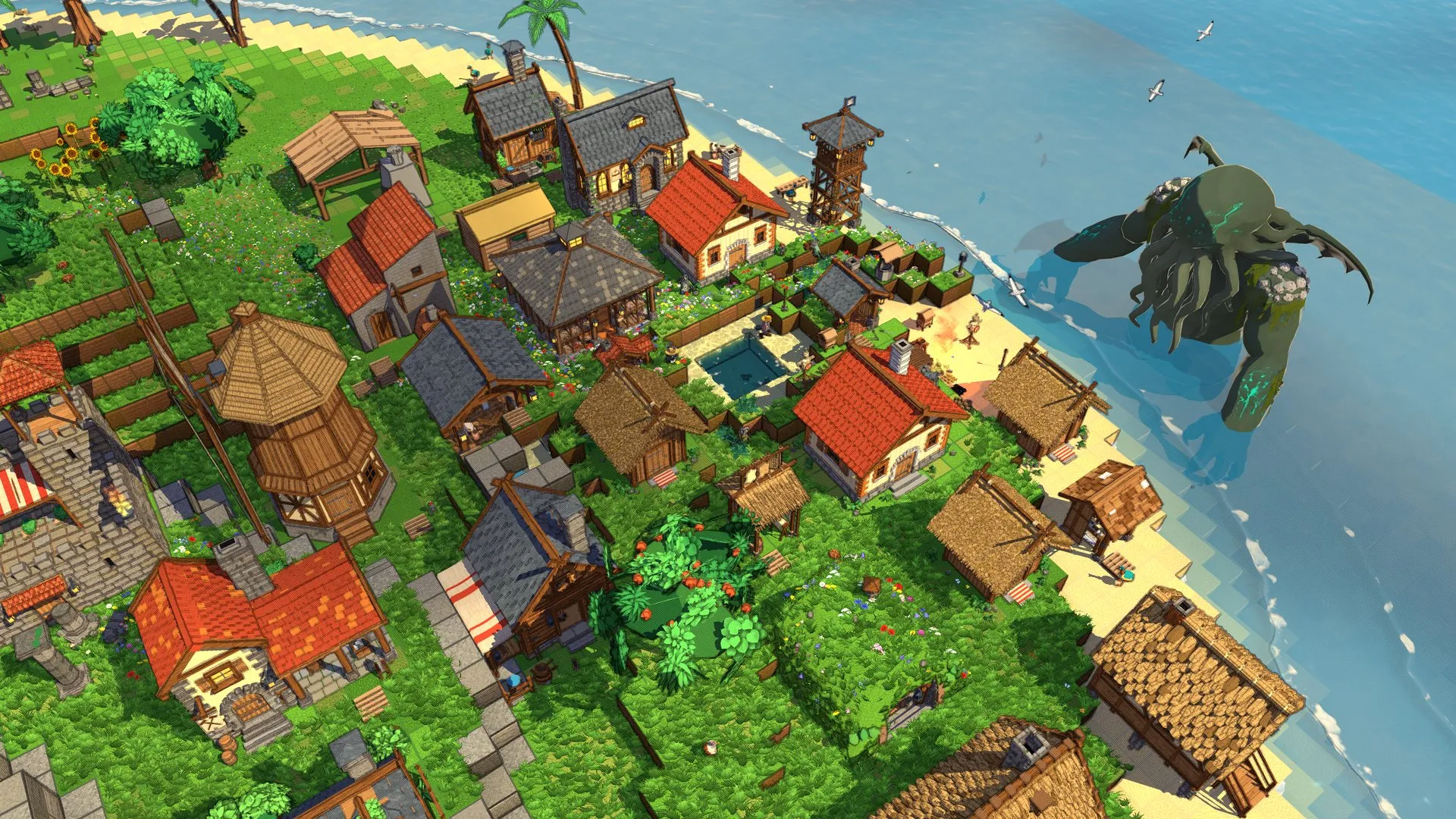
Buildings now go up the way buildings do: from the bottom. A site has its full size from the start, you just see only what the builders have built so far. The cut is straight, and just below it a light band shows where they are working. The mill’s sails and the sawmill’s wheel pop in once the walls reach them, and the roof comes last, as it should.
A finished building can be upgraded from its window. For now the hearth can: it gets a cauldron from the smithy, room for a second cook and recipes that are boiled rather than roasted: fish soup, bone broth and porridge. Just mind that nothing is cooked on it while the upgrade is under way. The colony waits for its soup on an empty stomach.
Home sweet home
Raccoons can build a hut with room for two beds and, once they invent Masonry, a house for four. You put the beds in yourself, wholly inside the room. A raccoon whose bed stands in a house has a home and knows it: “Has a home: Hut (housemates: 2)”. He sleeps better under a roof. In a bed out in the open he sleeps worse, and when it rains he “Got wet in bed”.
For the demanding there is the better bed: it costs more, but he rests faster in it and gets up in a better mood. And a house with beds in it cannot be torn down. Beds first.
Up the stairs, over the water
A raccoon can jump up one block and climb two. For a taller cliff or a deep pit, you now give him stone or wooden stairs: drag them from the foot of the wall to the top and the builders lay them piece by piece. On stairs you walk instead of jumping, and raccoons take them of their own accord even where they could have climbed.
A footbridge is dragged from bank to bank, over a stream, a river, a pond or a ditch you dug. It is made of planks and rope, a longer one stands on pillars, and it grows from both banks. The builder will not nail down the last piece while somebody is wading underneath. Consideration, or self-preservation? Hard to say.
A bed overhead
The Move tool sits next to Demolish. Pick up a finished bed, a lamp, a feeder, a piece of fence or a table with it and point to where it should go. A raccoon comes over, lifts it over his head and carries it off. Nothing is torn down, and the bed still belongs to whoever it belonged to. With a load over his head he never runs. A removal man has his dignity.
And if somebody happens to be asleep in the bed, it waits. Nobody is moving him along with it.
Pallets, and a store that says enough
Every workplace stacks what it makes on its own pallet, and the haulers take it away from there. Workshops with several inputs have input pallets too, and so that the brewery is not ringed with them like floor tiles, two fit one above the other on a rack. Nobody climbs up: the top shelf is high only for show.
A storehouse lets each kind onto only a few pallets, and how many is yours to set in its window. When a kind has nowhere to go, it stays on the building’s pallet, the pallet fills up and the work stops. So the store itself stops the colony producing what it already has plenty of.
Idle paws help out
An employee whose workshop has nothing to do waits a moment, then goes to help elsewhere by his priorities. As soon as there is work back home, he delivers what he is carrying and returns. And the other way round: when the employee is asleep or off hunting and the workshop has orders, anybody free who knows the work steps in for him.
Keep ten
The workshop’s window is a table: the item, its inputs, the stock and the target. For each recipe you set how many the colony should always have (or ∞), and you can add a few extra pieces right away. The workshop picks whatever is shortest by itself.
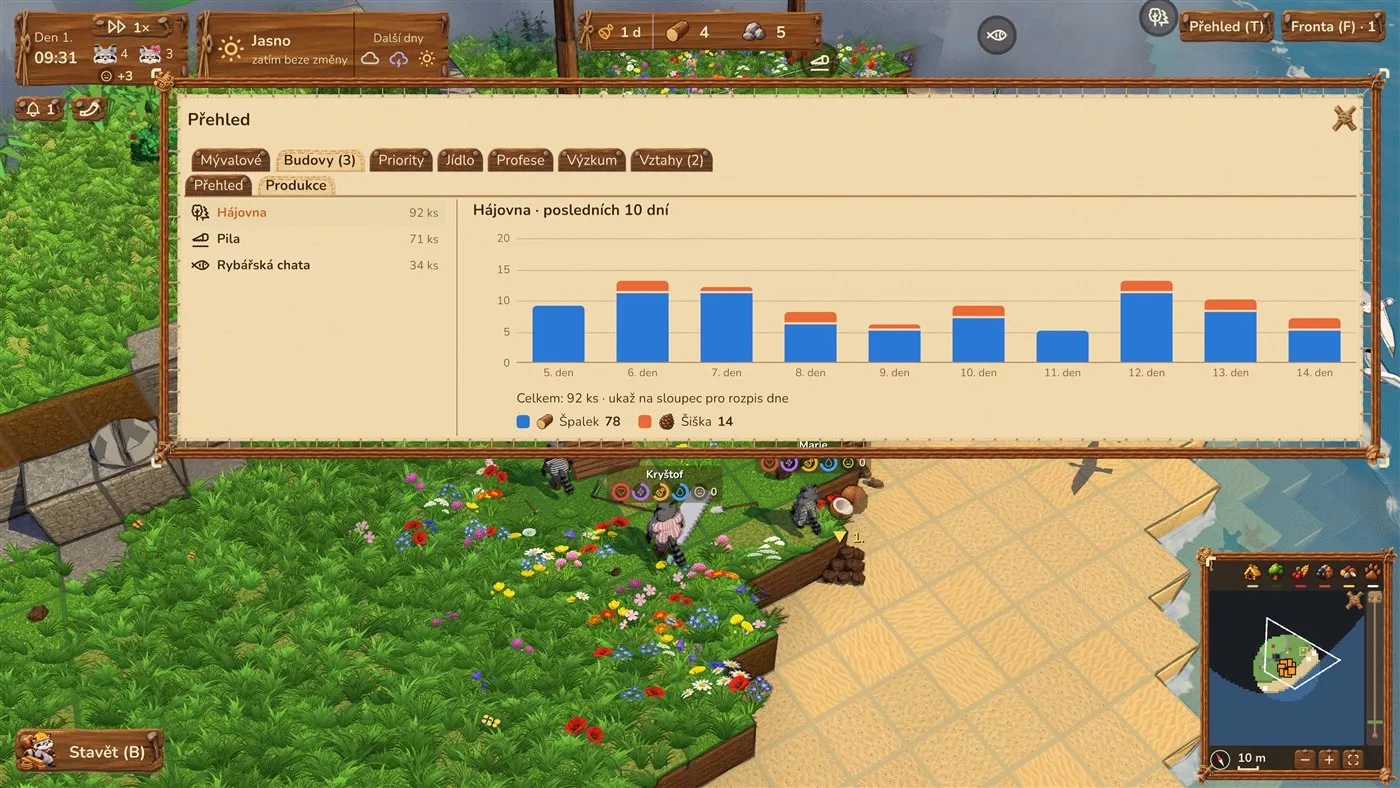
Under Buildings in the Overview there is now Production: a chart of what each building made over the last ten days and why it stood idle. And the Production tree shows the way from the first campfire to bread, with the professions that open each building.
Odds and ends
- Your own start. On a custom island you choose one to ten raccoons, Meagre, Normal or Plenty of supplies, and cubs for the pairs.
- The smithy forges from bars. Its forge burns coal, and the smith fans it up only when there is something to forge.
- The table. The cook lays the hearth’s table with what the diet says and keeps it varied. You can build more tables.
- Tannery and joinery. Leather goods are sewn by the Tanner, buckets and shovels made by the Joiner.
- The watchtower sees around itself with no raccoon in it, and further from a hill. Wild animals now hide in the grey fog.
- Marks over sites. Instead of long tags, a circle with the building’s picture, its progress and what it lacks.
- The farmstead’s window has sections, its pens as tabs and Auto-assign.
- What a store takes. Storehouses and larders have filters. Food a larder turns away goes to another one, never onto the ground.
- Gathering. A new Overview tab: a snake of tiles in the order things are gathered, and a Banned strip.
- On the way. A raccoon who has just dropped off a load and is hungry grabs a bite if food is close by, then goes back to his own work.
- Doors count. Raccoons go into buildings through the door and no longer try to get in through the roof.
Coming up
The houses stand, the pallets fill and the stairs reach the top of the cliff. What waits up there is for another time.