The raccoons found out that the island has more than a top. It has an underside. And the underside can be dug.
Cube by cube
Digging goes by whole cubes. Dig takes a cube away, Heap adds one. Under the blows a cube cracks, a little at first, then more, and the last blow breaks it in a puff of dust. Soil gives one soil, rock one to three stones, and a deposit’s cube spills its coal or ore on top. A digger whose soil piles up with nobody coming for it carries it off himself. He does not need a foreman for that.
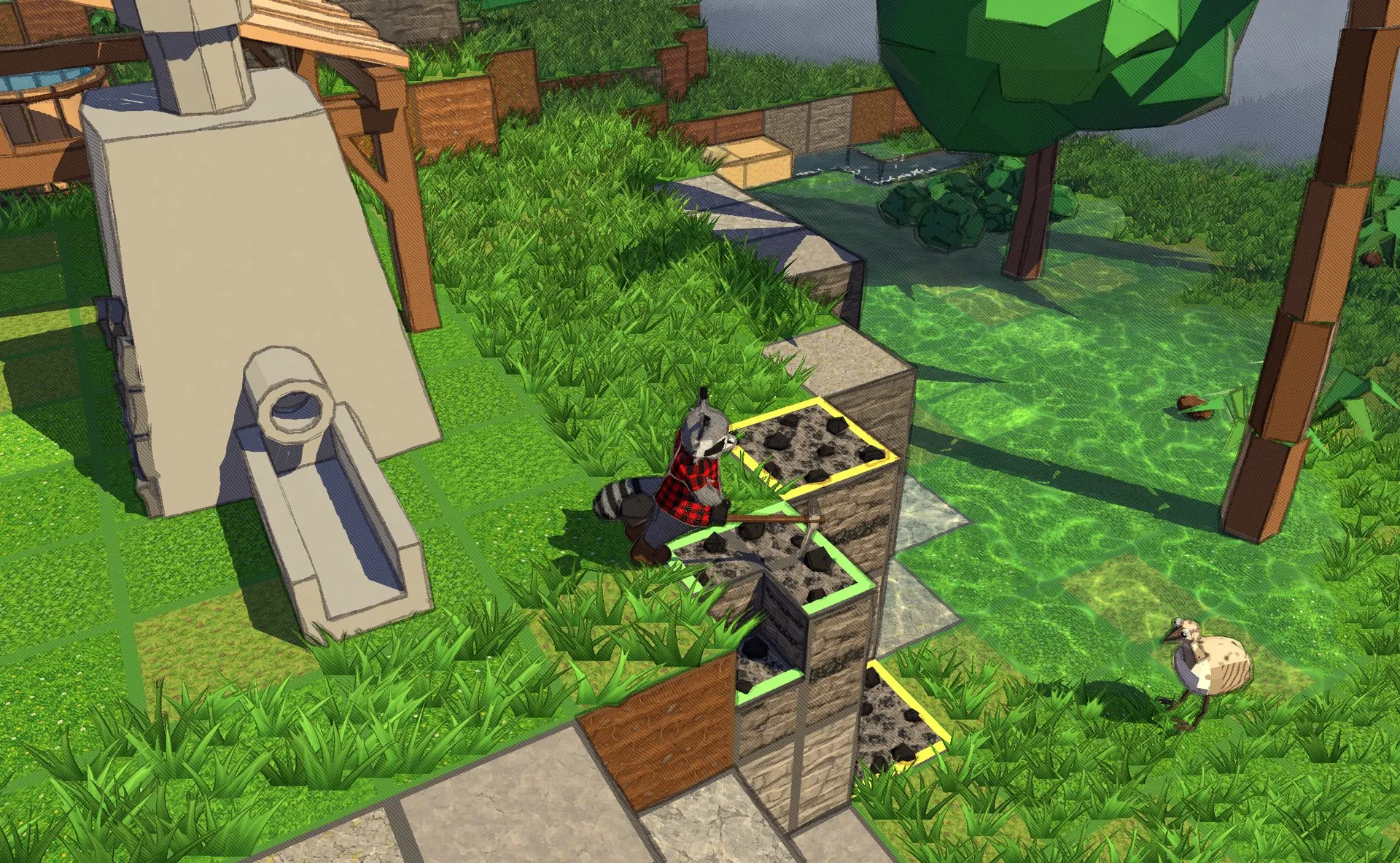
You can dig sideways too: into a hillside, into a cave’s ceiling, or a whole tunnel, a cube wide and two high. Heap, for its part, builds a cube into the air in front of a wall: a step, then another step, then a bridge. You can heap up to twenty metres, so when the island’s recipe turns on Sky islands, you can build a staircase of soil up to them.
What holds, holds
A cube stays up only if it is joined to the ground through its neighbours. Dig out a pillar’s foot and it comes down. A tree whose roots you dig out from under falls as if felled, and a boulder drops into the cave below, stones and all. The game at least looks after buildings: a dig that would bring something down under a hut is refused with “That would bring down the ground under a building.” So is a ceiling that would get too thin: “The cave’s ceiling would not hold here.” The raccoons never studied structural engineering. The island did.
Caves
The generator hollows caves into the hills: mouths, tunnels, rooms, a cellar under some and a gallery over others. It adds rock arches and overhangs. It is dim inside, so a lamp belongs there, and it shines as long as it has wax. It never rains in a cave, which makes it a good place to sleep. Only a bed, a storehouse, a lamp and a mine may go underground. Raccoons are not moles.
Somewhere in a corner of a cave stands a chest. It may hold food, rope, planks, clothes or iron, and now and then a beer. Some are guarded by a skeleton with a sword, who is not in a sharing mood about the beer.
How to look inside a hill
Shift and the wheel (or PgDn and PgUp) cut the whole island a cube lower, and Escape puts it back. A label under the top bar says how deep the cut goes (“Cut −2”), a bar beside the minimap shows it too, and whatever the cut removed hangs over it as a faint ghost. Where the plane slices the ground lies a hatched lid, and resting the pointer on it says what is under it: “Cut: rock”.
You do not have to look at a raccoon in a cave through anything. Select him and whatever hides him, the ceiling, the hill, the tree on the hill, is cut away by itself, while whatever lies beyond him stays.
The fog under ground lifts cube by cube. A raccoon sees six cubes through the air, round a corner only as far as he has left after getting there, and up and down a shaft. A cave reveals itself as the raccoons walk through it.
The geologist taps
Under the island lie seams, deeper than any shovel reaches. Outcrops on the surface hint at them. The big seams of coal and iron lie under the feet of the high mountains, the small ones are scattered everywhere, and there is water among them.
The geologist finds them: a digger with a bit of training and a geologist’s hammer. With G or the Survey order you show him a circle, and he walks it, tapping the ground and listening, like someone knocking on a door. Where he finds something he plants a stake, and the more notches it has, the more there is. Where he finds nothing but something lies close, he plants a smaller stake leaning that way: a trace. From a geologist’s shelter he surveys the land round it on his own.
Mine and well
A mine can only be built over a seam the colony knows of, and only after the Mining research. The miner climbs in and vanishes, and out come coal and ore onto a pallet. Near the end he digs slower, and once the seam is empty the mine is left abandoned, its mouth boarded up. A miner is a geologist with more training, because who would dig where nobody tapped first?
Over known water you can build a well. It fills by itself, the faster the more water lies under it, and it never runs dry.
Stone without digging
Rock is not the only source of stone. Boulders and menhirs are mined with a pickaxe, stone by stone, shrinking as they go. A boulder gives a few stones, a menhir twelve, and neither grows back. Ruins come apart in three stages: first the ivy goes, then the tops of the walls, and in the end only rubble is left. Small ones can be marked by dragging a box, great ones only by a click, so nobody knocks down a monument by accident. Where a ruin stood, grass grows and you can build. Archaeologists would weep. The raccoons are counting stones.
Soil grows over
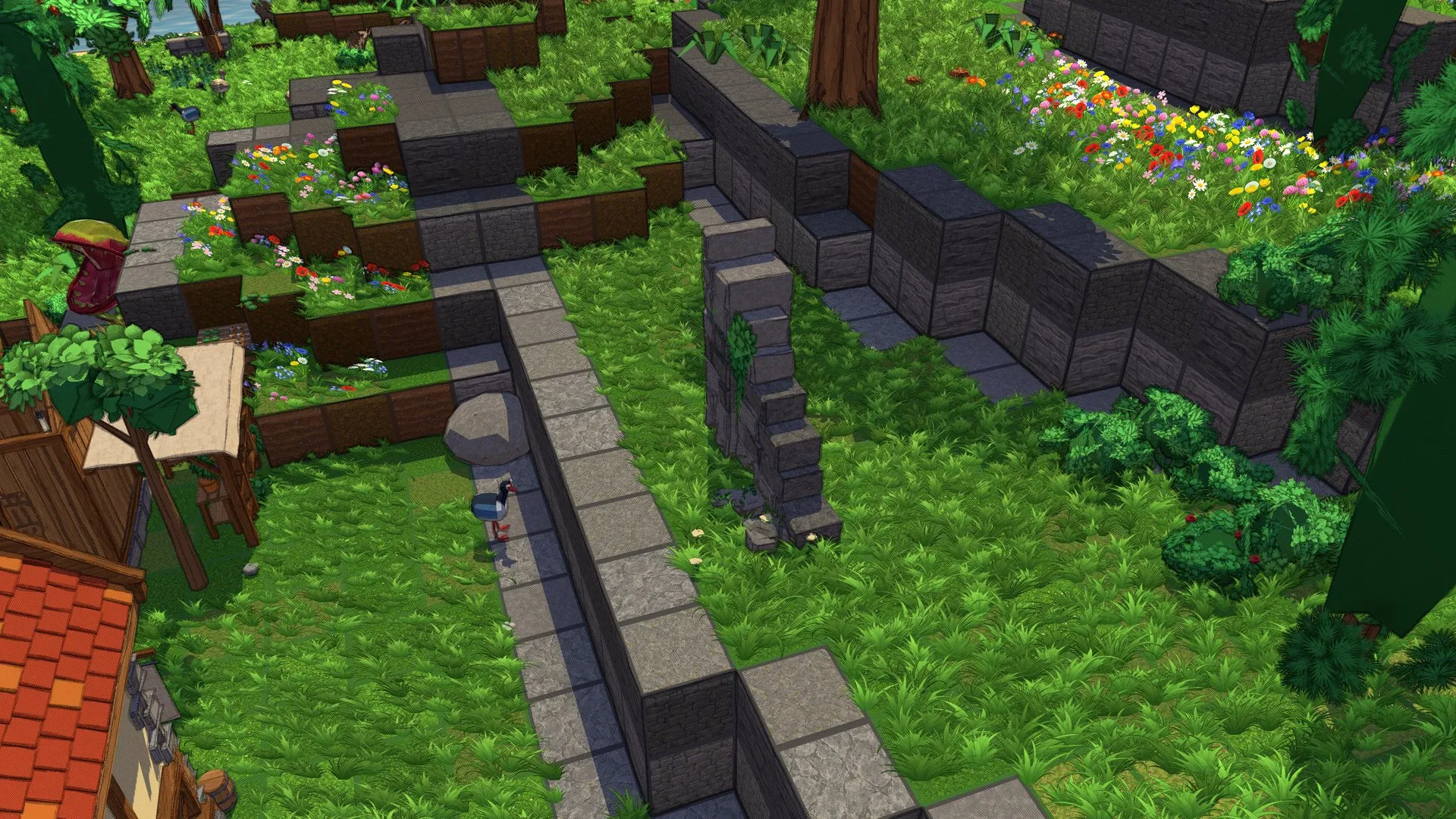
Dug and heaped soil is bare, and in about two days grass grows back over it by itself. Faster in the rain. While it is bare, nothing grows on it by itself: no nettles, no mushrooms, no wild grain. You can still sow or build on it, though. And in the map editor you can paint soil that never grows over.
Odds and ends
- Minimap layers. Six buttons over the map hide or show Buildings, Trees, Food to gather, Ore deposits, Items on the ground and Animals. Plus buttons to zoom in and out, to show the whole island, and a scale.
- Cubes have outlines, so you can see where one ends and the next begins.
- A cliff is rock. Its top is a cube of soil, and under that is rock, which needs a pickaxe.
- Water runs into caves through the mouth and down a shaft, and a flooded cave pushes it back up the shaft.
And not everyone who lives in a cave is a raccoon.