Until now the colony grew only by whatever the sea washed up. Now it grows on its own as well, with everything that entails: bibs, pranks, and a family tree you will lose track of within a few generations.
Girl raccoons
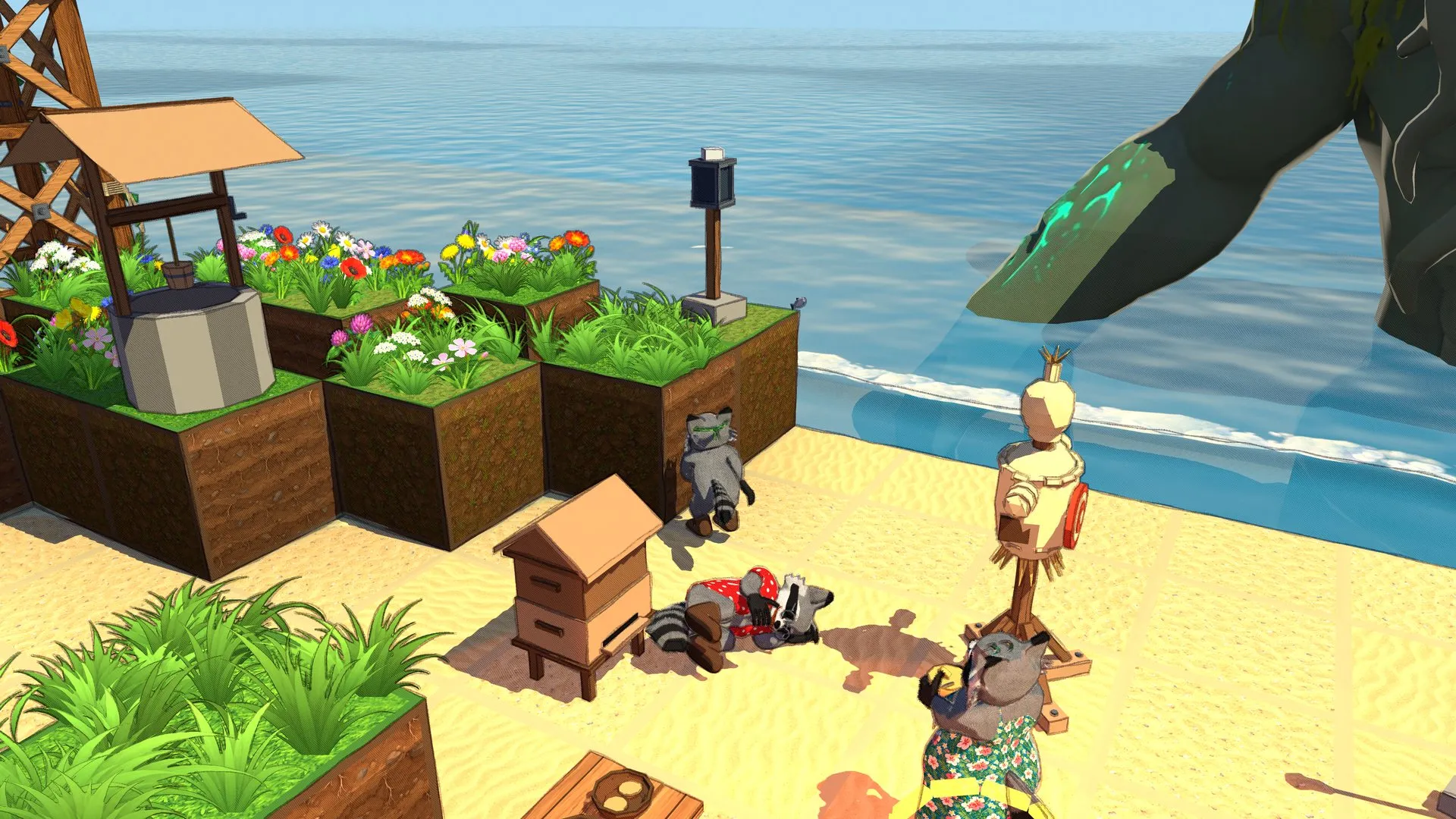
There are girls among the raccoons now, and you can tell them at a glance: long lashes, a bow between the ears in the pattern of her dress, and a dress where a boy would wear a shirt. Girls do not wear shirts and boys do not wear dresses; they have agreed on that. Otherwise they work, train and eat exactly the same. The game speaks of each in her own words (“Amelia has collapsed”), the clock shows how many of each there are, and a new game’s crew always has both.
Expecting
A couple who are doing well have a cub all by themselves. The player has no say in it, which is as it should be. All you can do is keep them both at least content (a happy couple’s chances are more than twice as good) and keep food for three days in the stores. Then one morning the news arrives: “Amelia is expecting a cub.” She expects for two days, carries on working and is rather pleased about it.
The cub is born in front of his mother: small, with a head a size too big for him, and a name from the list. A heart pops up over both parents and the game announces: “Amelia and Guy have a cub: Cornelius.” He starts out as a friend to both of them. A happy couple now and then has twins.
A bed for the cub is your job. Without one he sleeps on the ground and remembers it in the morning, like anyone else.
The cub won’t work
For three days the cub is a little raccoon in a white bib and a knitted bobble hat. He eats (half as much), drinks, sleeps, chats and sticks by his mum. If mum wanders too far from home, he sticks by dad, and if dad does too, he plays at home.
Work, however, he will not. His row in the priorities is grey and locked, under his name it says “A cub does not work (grown in 3 days).”, and anyone hoping to arm him finds the button greyed out with a single word: a cub. No dog for him, no beer either. He runs from every danger, which at his age is the most sensible thing he knows how to do.
The teenager
Then come three days of being a teenager. The bib and bobble hat go, a green headband of grass takes their place, and with it the pranks. The teenager roams round home looking for mischief, and then he finds it. He raids the pantry. He scatters a pile by the store. He tramples a field, which then grows again from the sowing. He chases the hens, so one of them lays nothing that day. He hides a tool some way from the store. And at night he wakes a sleeper: “Gertrude lost her sleep: Cornelius woke her.” Cornelius takes away the impression “Pulled a prank” and a splendid mood.
The worse a teenager is doing, the more trouble he makes: a happy one pulls a prank about once every two days, an unhappy one twice a day. And one more thing helps. If a grown-up is awake nearby, the prank does not happen: an exclamation mark pops up over the grown-up and the teenager acts as if he was only passing by. Upbringing here is half mood and half whoever happens to be standing by the pantry.
Grown up, with two traits
Cubs and teenagers fill Cheer and Gloom like anyone else; it just does them no good yet. It does when they grow up. The first trait comes from childhood: from the fuller vessel and by whatever filled it, so a happy childhood by the fire gives something other than a hungry one. The second, with an even chance, comes from a mentor: the grown-up who stopped the most of his pranks. Whoever keeps an eye on him brings him up, and every prank stopped makes the two a little fonder of each other. If nothing is passed on, he gets a trait he was born with instead.
“Cornelius has grown up. From childhood: Jolly. After his mentor (Gertrude): Workhorse.” He also gets his aptitude (his mentor’s, if the mentor has one), his full size, the beard that was always coming to him, and work. Not a shirt, though. That he gets the way everyone does: by your order to Get dressed.
Mum’s eyes, dad’s arms
A cub’s talents are the average of his parents’, with a little chance on top, less than a castaway’s. Strong parents have a strong child; two thinkers will more likely raise a thinker. Build and eye colour come from one parent or the other. Twins are not identical: each has his own talents, looks and name. And kin, parents with their children and siblings, never pair up, however fond they are of each other.
The family tree
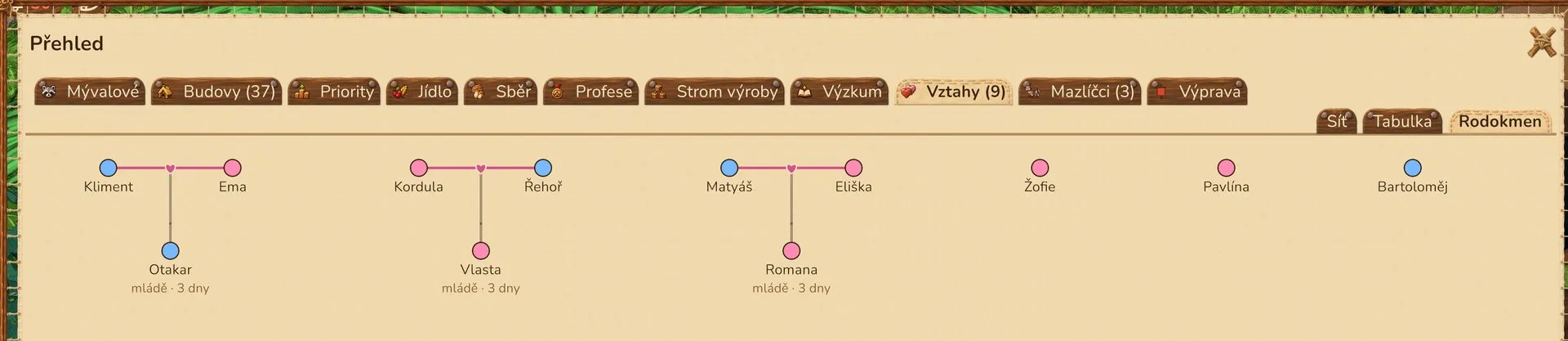
The Overview (T), under Relationships, now has a third view next to Net and Table: Family tree. Generations in rows from top to bottom, couples joined by a heart, their children beneath in order of birth, twins side by side, the dead greyed out with a cross. Someone who had a child with a new partner after the first one died has a partner on each side. Click on a living raccoon and the camera goes to him.
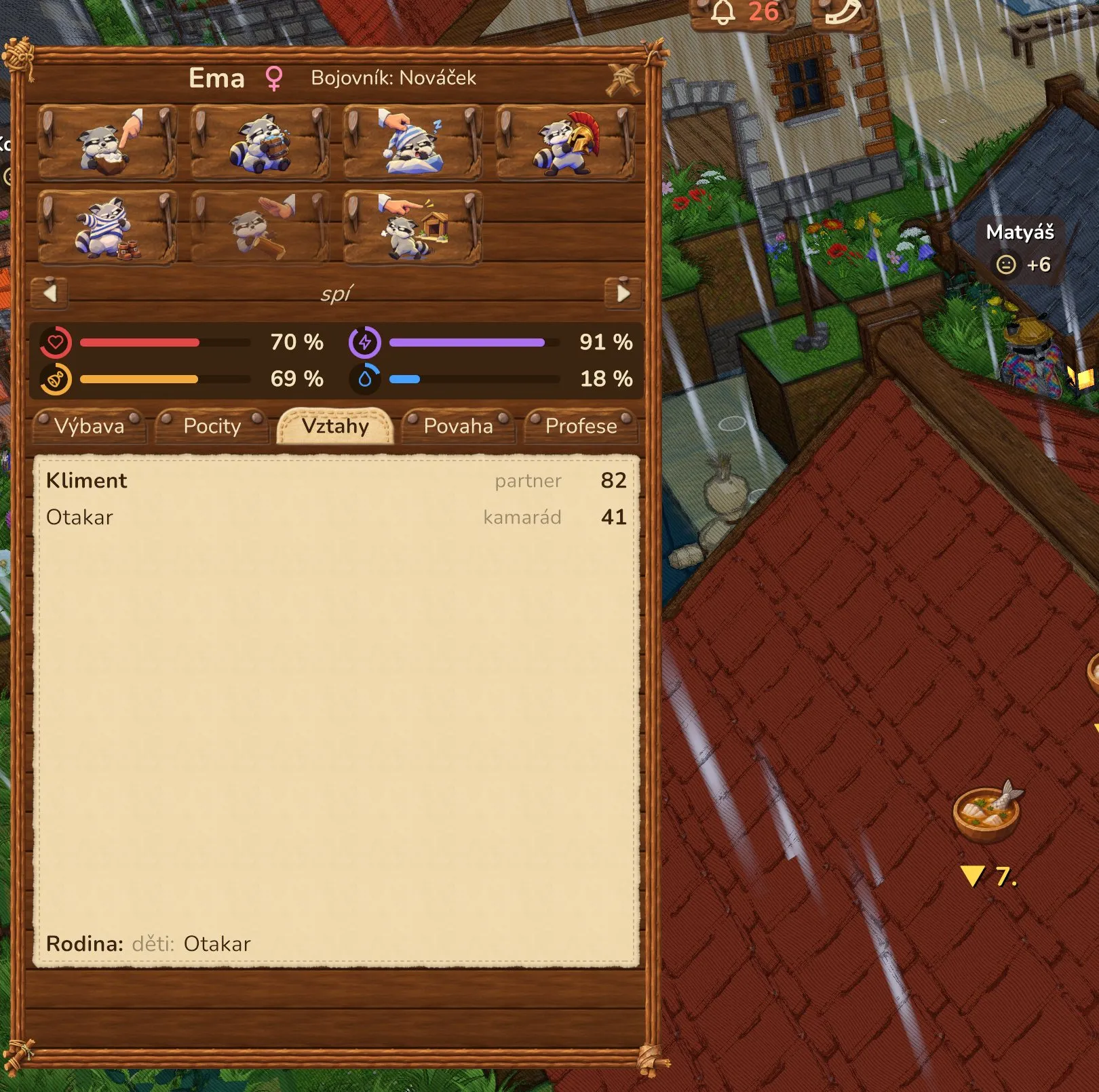
The raccoon’s card has a new line on its Bonds tab, Family: mum, dad, children and siblings, each by a name you can click.
Odds and ends
- Cubs and teenagers in the table. The work cell says “cub · 3 days” or “teenager · 2 days”, and the doing column “staying by mum”, “roaming round home” or “looking for mischief”.
- A head to grow into. A cub’s head starts out big and evens out as he grows.
- The father did not live to see the birth? The cub is born all the same, with his father’s talents in the mix.
- A cub who loses both parents stays at home by the campfire.
- A new game with a family. A new game’s settings can start with couples and with cubs right away.
What it all comes to
Raccoons do not grow old, so the only things holding a colony back now are food and mood. And teenagers, who eat the food out of the pantry.