For a long time a raccoon was happy with food, water and somewhere to sleep. Not any more. The raccoons now have moods, a nature, friends, partners and, now and then, somebody they simply cannot stand. Everything that comes with living with other people, in short.
A face over every head
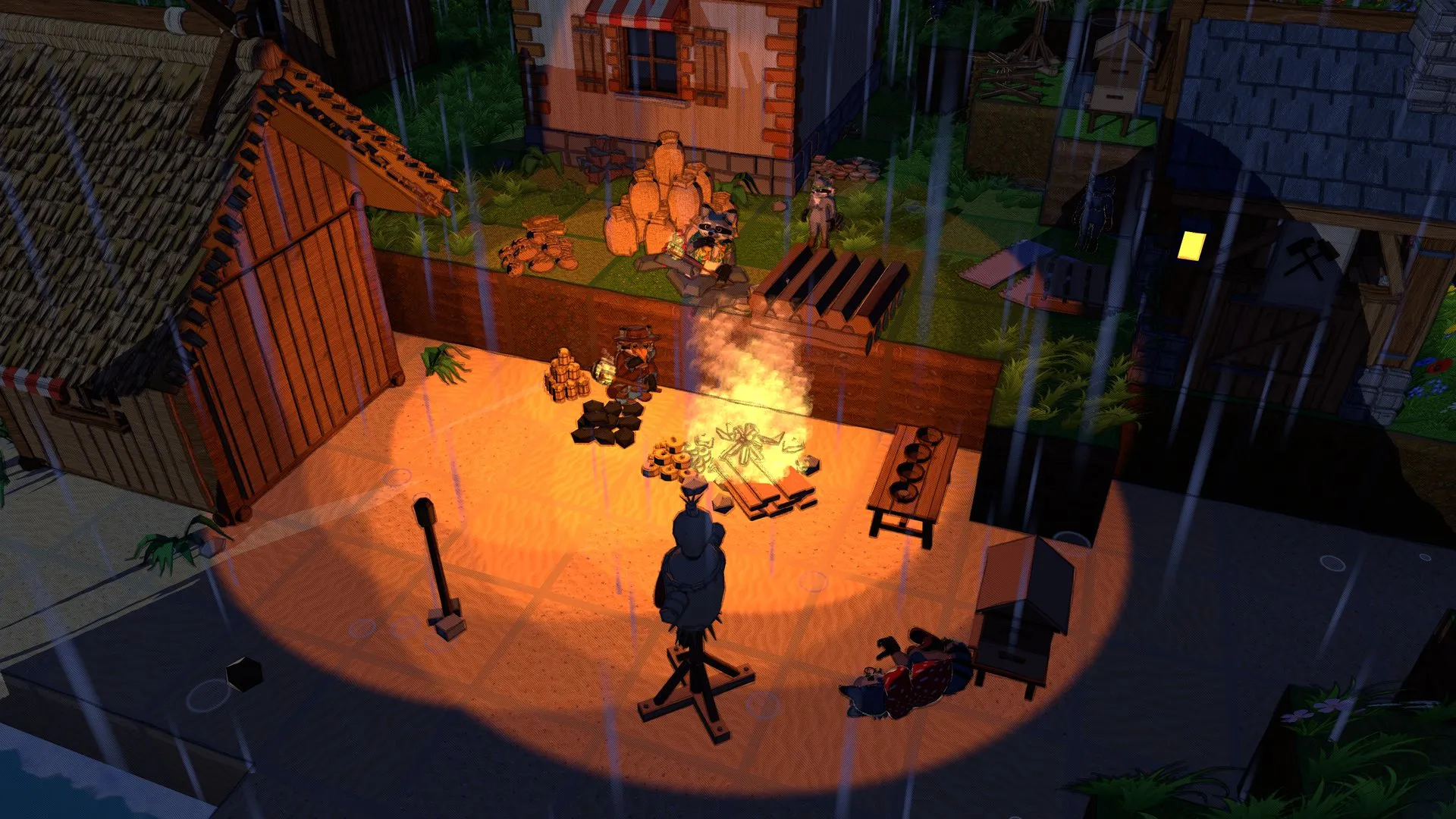
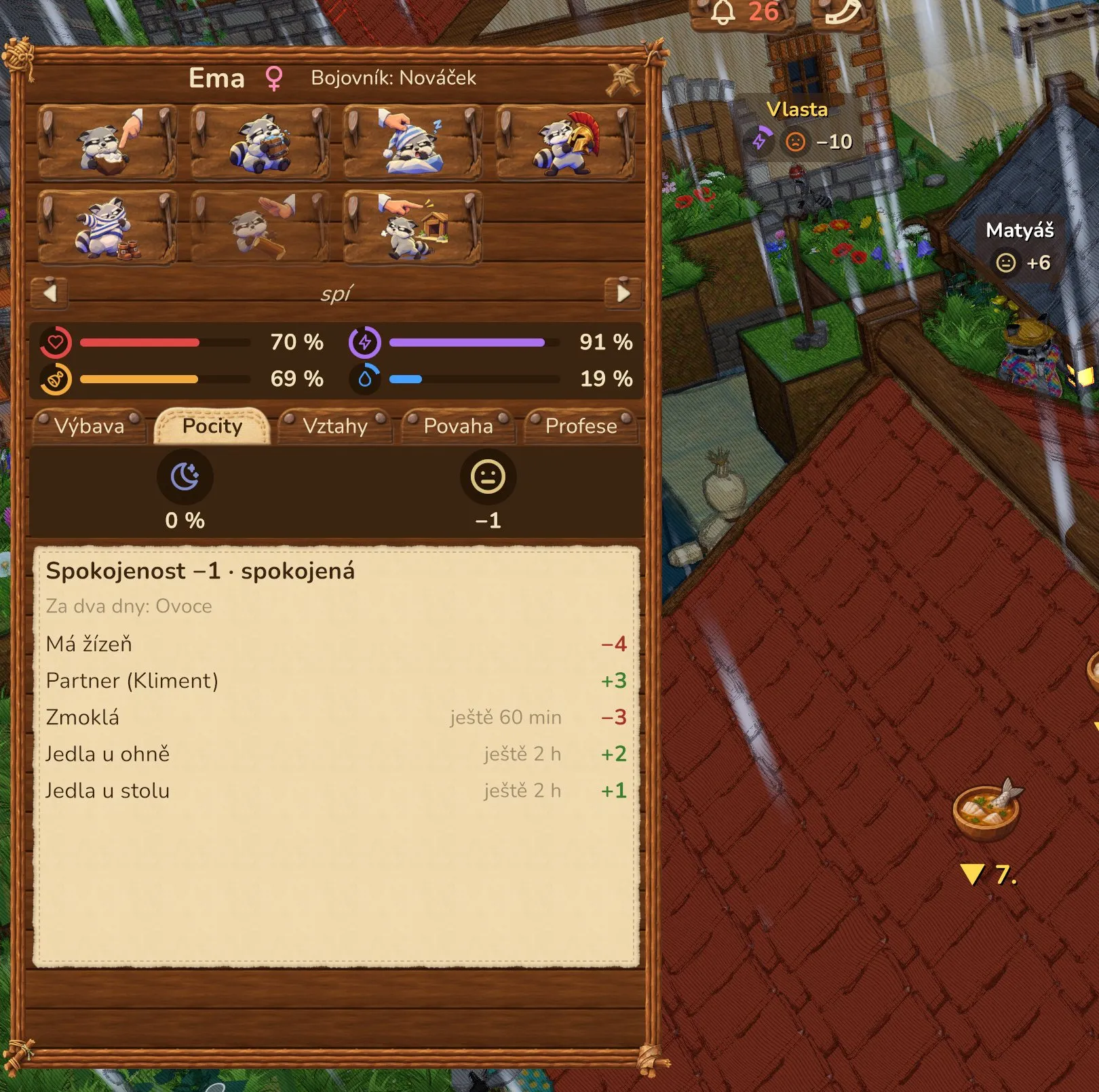
Contentment is a fifth need, and it is made of impressions. Slept in his own bed: plus. A warm meal: plus. Sat by the fire, danced, had a chat: plus, plus, plus. Slept rough in the rain, hungry, an unburied body lying nearby: minus. Nothing drifts back on its own; contentment is the plain sum of what a raccoon feels right now, and a face with a number shows it over his head.
A happy raccoon works and learns a good bit faster. An unhappy one is slower and grumbles in a sad bubble now and then; a miserable one is slower still and grumbles twice as much. What exactly is wrong is on the raccoon’s card, under Feelings: impression by impression, with how long each one still lasts.
A nature you can raise (or ruin)
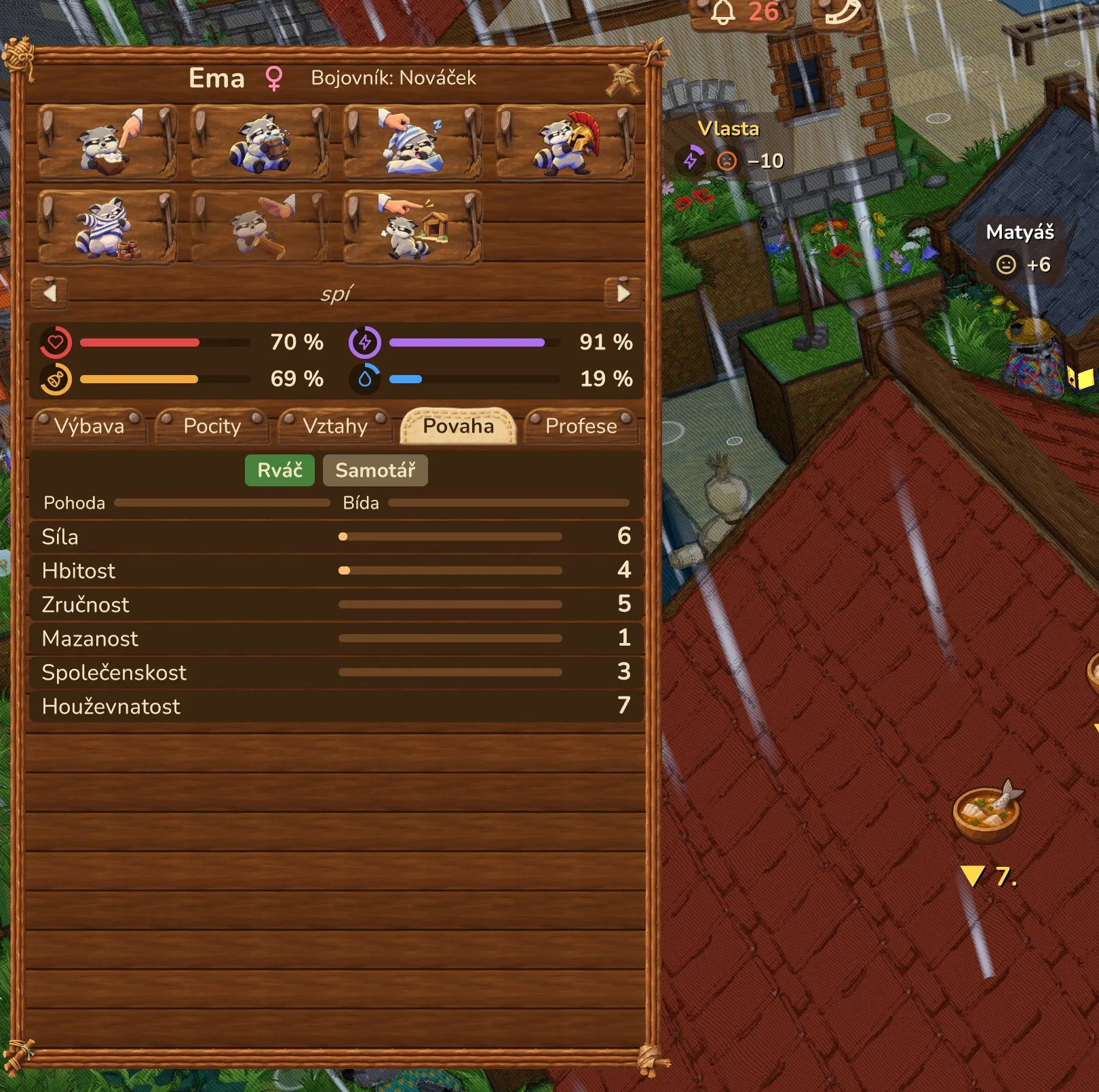
Under Nature, every raccoon has his traits. There are 28 of them: good ones, bad ones and trades that give something and take something. Jolly is in a better mood on principle. A Softie feels everything more, an Easygoing raccoon feels everything by half. A Night owl does his best work between ten at night and five in the morning. A Loner never starts a conversation; he says hello in passing and that is your lot. And a Teetotaller will not touch beer, but he is better company for it.
Every raccoon is born with two traits, drawn by his talents (the strong ones tend to be Brawlers). The rest he earns by living. Under the traits sit two vessels, Cheer and Gloom. Long happiness fills Cheer, and when it overflows the raccoon first outgrows a bad trait; if he has none to outgrow, he gains a good one. Long misery fills Gloom, and Gloom hands out bad ones.
Which trait arrives depends on what filled the vessel. A colony that goes hungry all the time raises Gluttons. Sleep on wet ground often enough and you turn Shivery. Before a nature sours, the game warns you: “Boniface: gloom is souring his nature.” Five traits at most.
Friends, best friends and couples
Raccoons who talk, dance, sit by the fire, eat or work side by side grow fonder of each other. A couple of days apart and they drift. Acquaintances become friends, friends become best friends. And best friendship need not be mutual: Boniface may count Gertrude as his best friend while she counts him as a friend. That is life.
Friends chat more often, and a chat with a friend cheers more. When two raccoons of opposite sexes have been each other’s favourite for long enough, they become a couple, and couples never split up; only death parts them. A partner is a lasting comfort, twice so when their beds stand in one house, and where the beds go is up to you. A friend’s death hurts more than anyone else’s; a partner’s hurts most, and longest.
There is a sixth stat, too: Sociability. A chat with the life and soul of the colony cheers more, and a content raccoon with a bit of Sociability comforts an unhappy one, who gets a heart over his head for it. It trains by talking, except that the first three chats of a day do not count. Those are just good manners.
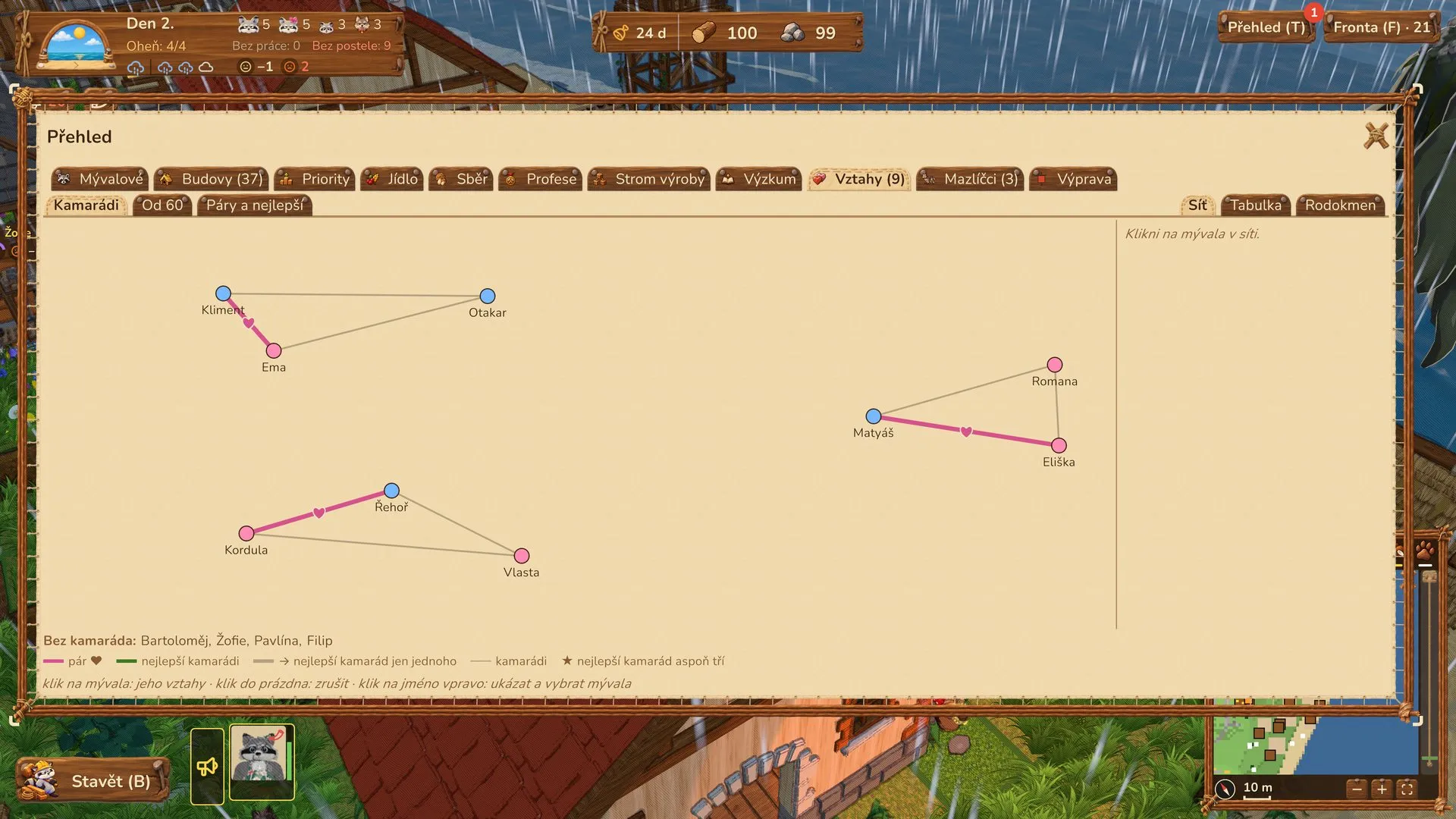
Who is fond of whom is on the card’s Bonds tab and, for the whole colony, in the Overview (T) under Relationships: a net where couples are joined by a pink line with a heart, mutual best friends by a green one, and one-sided ones by a grey line with an arrow pointing at the one being adored. A raccoon who is best friend to three or more gets a star by his name.
Shoving and rivals
On the path between the store and the fire, two raccoons sometimes meet. Mostly it ends politely: whoever is just standing about steps aside, and friends wave. But a raccoon with a load, in a bad mood or with a short fuse gets cross, and then Sociability decides. The ones who are good with others merely grumble ”#@!”. The ones who are not, shove. The other one staggers, and the game reports it faithfully: “Gertrude shoved, Guy staggered.”
Clash often enough with the same raccoon and a grudge builds; a big enough grudge makes rivals. Rivals do not chat, never become a couple, and spoil each other’s mood wherever they meet. A Hothead will bump into his rival on purpose once a day. A special case are the cockerels: two raccoons both sweet on the same girl. Once she picks one of them, the other will hold it against him for a long time.
You can only part them indirectly: another workshop, another house, another fire. Kept apart long enough, they make up and shake paws. A content colony hardly ever shoves, by the way. When the shoving starts, something is missing.
The colony’s mood
In the clock, under the count of raccoons by sex, there is a face for the whole colony with its average, and a red count of the unhappy if anyone is suffering. Rest the pointer on it to see who is unhappy (click a name and the camera goes to them), what troubles the colony most and what pleases it. When half the colony is moaning about sleeping on the ground, you know what gets built tomorrow.
Odds and ends
- Aptitudes. The priorities (P) now have a column for each root of the profession tree: Woodcutter, Digger, Gatherer, Builder, Hunter, Workshops, Hauler and Fight. Every adult has an aptitude, one of the first five, which puts its column at 1. A new game’s crew is dealt like a hand of cards, so the start never lacks a woodcutter, a gatherer, a digger or a builder. Fight is now simply yes or no.
- Settled points. A stat a raccoon holds at its peak for long enough may settle and never drop below its new floor: “Guy’s strength is settled: never below 6.”
- Rescuer and castaway start out as good acquaintances. A raccoon remembers who held out a paw.
- Messages under the clock. Messages moved to the left, under the clock, with a bell counting the unread and a Messages window for whatever you missed. The “+1” for a load delivered rises right over the store it landed in.
- The island lives without raccoons too. Butterflies over the meadows, fireflies at night that flash together like a choir, gulls circling over the sea, and now and then a fish jumping out of the water.
Coming up
And what happens when a couple stays content for long enough and the stores hold food for three days? That is for next time.